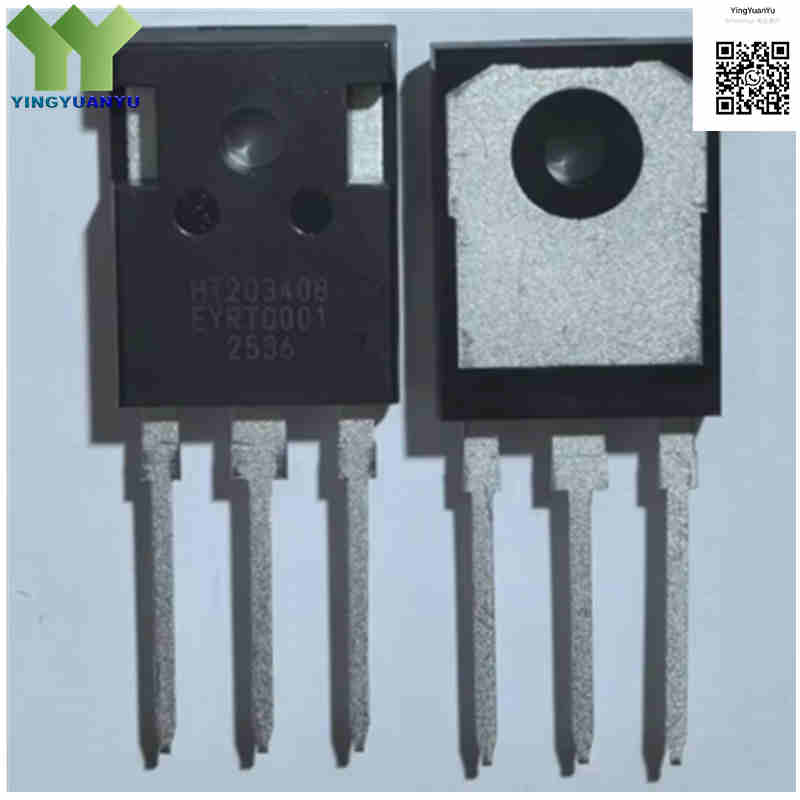
HT20340B
| Part Number | HT20340B |
|---|---|
| Manufacturer | Watech |
| Category | RF Semiconductors > RF Power Transistors |
| Description | 10‑300MHz 400W N‑Channel RF Power Transistor, TO‑247‑3L Package for Broadband RF Amplifier Application. |
| Stock Status | In Stock |
| Origin | Original Factory |
Product Overview
The HT20340B from Watech is high‑power N‑channel RF power transistor, providing 400W continuous output power within 10‑300MHz frequency band. Optimized for broadband CW and pulse RF power amplification. TO‑247‑3L power package brings outstanding heat dissipation performance, widely adopted for short‑wave transmitter, VHF radio equipment and industrial RF power source.
Core Advantages
High Continuous RF Output Power
Delivers up to 400W RF output power, satisfies high‑power broadband transmitting requirement for industrial and radio application.
Wide Operating Frequency Bandwidth
10‑300MHz wide frequency coverage, suitable for short‑wave, VHF broadband amplifier circuit design.
Excellent Thermal Performance
TO‑247‑3L through‑hole power package with low thermal resistance, stable performance under long‑time high‑power working condition.
High Gain & Good Broadband Stability
Typical 13dB power gain, stable working characteristic for both continuous‑wave and pulse mode RF system.
Key Specifications
| Brand | Watech |
|---|---|
| RoHS Status | RoHS Compliant / Lead‑Free |
| EDA/CAD | Symbol, Footprint & 3D Model Available |
| Warranty | 1‑Year Standard Quality Warranty |
| Package / Case | TO‑247‑3L |
| Mounting Type | Through‑Hole |
| Surface Marking / Silkscreen | HT20340B Marking |
| Device Type | N‑Channel RF Power MOSFET |
| Output Power(Pout) | 400 W |
| Frequency Range | 10 MHz ~ 300 MHz |
| Supply Voltage(Vds) | 50 V DC |
| Power Gain(Typ) | 13 dB |
| Thermal Resistance (θjc) | 0.35 °C/W |
| Operating Temperature Range | -20°C ~ +85°C |
| Packaging Format | Tube |
Typical Applications
- Broadband RF power amplifier
- Short‑wave & VHF radio transmitting equipment
- Industrial RF heating power source
- CW / Pulse RF transmitting system
- Lab RF test transmitter equipment
Order & Shipping Info
| Minimum Order Quantity (MOQ) | 1 Piece |
|---|---|
| Shipping Time | Shipped within 1‑2 business days |
| Delivery Time | 3‑7 working days worldwide |
| Shipping Methods | DHL, UPS, FedEx, EMS |
| Payment Methods | T/T (Bank Transfer), PayPal, Credit Card, Western Union |
Technical Support
For datasheet, sample requests, stock check, or bulk pricing, please use the Quick Inquiry form. We will reply within 24 hours.
Frequently Asked Questions
Q1: What package does HT20340B use? Any other package versions?
A: Only TO‑247‑3L through‑hole package. No SMD, SOP‑16 or DIP‑16 variants. Thermal grease and heat sink are required for full‑power operation.
Q2: What is the operating frequency range?
A: Rated 10‑300 MHz. Gain and output power drop rapidly above 300 MHz. Operation beyond this band is not recommended.
Q3: Are there suffix variants such as HT20340A / HT20340C?
A: HT20340B is the complete part number. No official A/C suffix versions exist. Please check silkscreen upon receipt to avoid mixing‑up with similar RF transistors.
Q4: What are reference alternative parts?
A: Comparable options: BLF278, RD70HHF1. Pinout, supply voltage and gain differ. Matching network must be re‑tuned; direct drop‑in replacement is not supported.
Q5: What happens with poor heat dissipation?
A: Insufficient cooling causes high junction temperature, leading to performance degradation or permanent device burnout at 400W full power. Always apply thermal grease to heat‑sink contact surface.
Q6: Does it support both CW and pulse working modes?
A: Yes. It supports CW and pulse RF applications. Actual output power depends on heat‑sink design and system duty cycle.
Q7: How do I get datasheet, pinout or bulk quotation?
A: Submit an inquiry via our contact form. Our team will return datasheet reference, stock status and volume price within 24 hours.
Q8: Difference between HT20340B and HT20340S?
A: Both are TO‑247 family devices, but B and S suffix represent different functions with different parameters. They cannot substitute each other.
Related Products